

Clearing brain lipids during sleep!
Biologists around the world are now studying sleep in everything from fruit flies to jellyfish to understand the fundamental molecular and cellular mechanisms that drive slumber and answer the age-old question of why we sleep.
“Sleep is widely conserved across the animal kingdom and so it must have some basic function that is the same across species, and so what is that?” the senior author says. “We’re finally getting to a point where we are recognizing a few basic principles about sleep.”
The team were among the first to use fruit flies to study the cellular and molecular processes driving the need to sleep.
The team’s recent research suggests that the drivers of sleep are metabolic and that sleep plays a key role in protecting the integrity of mitochondria — the structures that power brain cells.
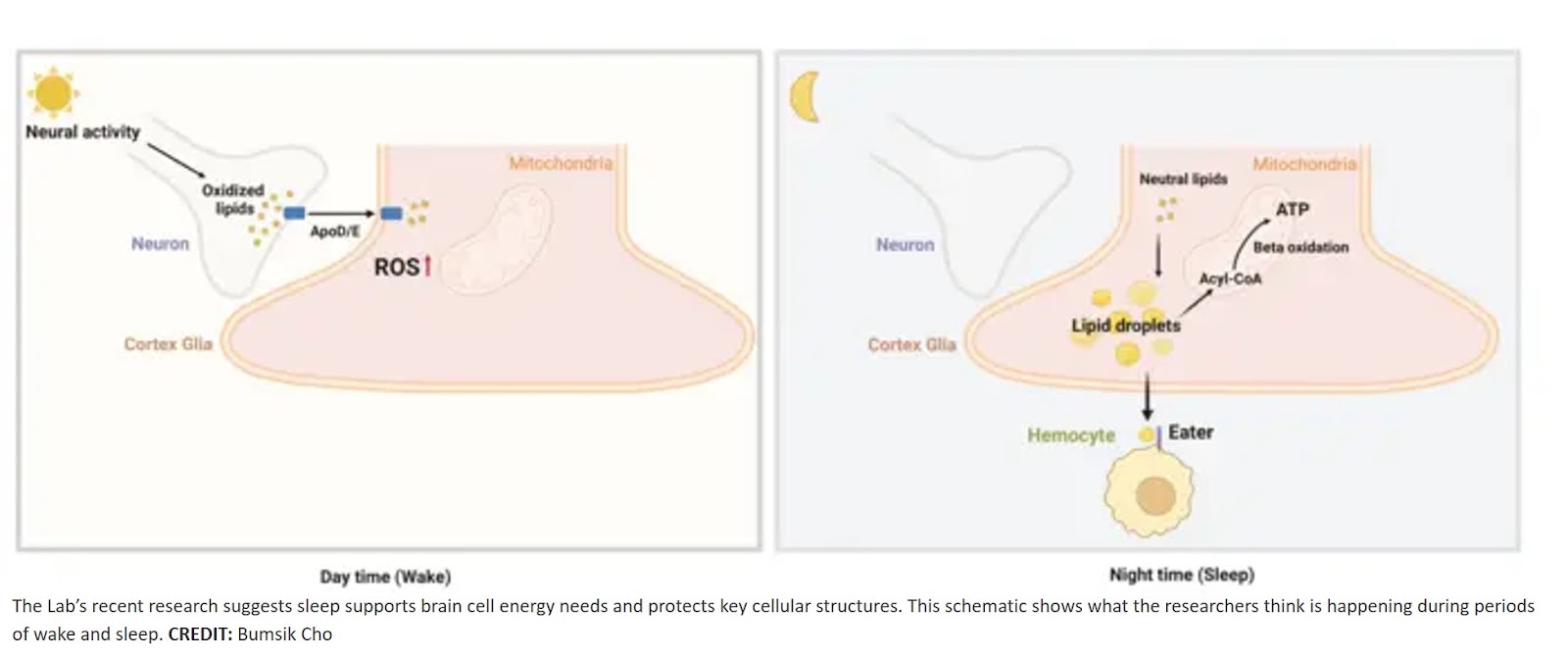
When we are awake, our neurons are constantly firing, powered by the energy produced by mitochondria. A byproduct of this energy production is reactive oxygen species, which can cause damage to the mitochondria and the cells that house them.
The team found that sleep helps neurons stay healthy by facilitating the movement of this oxidative damage to glia cells — a type of supporting cell in the brain — in the form of oxidized lipids. The glia break down some of these lipids to generate energy.
They also pass along some of the lipids to blood cells, which have specific receptors to receive them. The researchers identify a sleep function for peripheral macrophage-like cells (haemocytes) in the Drosophila circulation, showing that haemocytes track to the brain during sleep and take up lipids accumulated in cortex glia due to wake-associated oxidative damage.
The authors identify phagocytic receptors (eater) expressed in haemocytes and that knockdown of eater—a member of the Nimrod receptor family—reduces sleep. Loss of eater also disrupts haemocyte localization to the brain and lipid uptake, which results in increased brain levels of acetyl-CoA and acetylated proteins, including mitochondrial proteins PGC1α and DRP1. Dysregulation of mitochondria, reflected in high oxidation and reduced NAD+, is accompanied by impaired memory and lifespan.
“You need those neurons to be functional, and for them to functional, they need a reliable internal source of clean energy,” the author says. “One of the ways that sleep is helping the neurons stay healthy is by moving these lipids along to remove some of the oxidative damage.”
These findings all support the team’s hypothesis that sleep is driven by metabolic needs. When we don’t sleep, metabolic waste builds up in the brain, meaning neurons — and the energy-generating neuronal mitochondria — can’t function properly.
“We are super excited about our research right now,” the author says. “We feel like we’re sort of really starting to crack the whole sleep thing.”
The team’s findings on sleep regulation could help researchers better understand neurodegenerative diseases like Alzheimer’s, which are commonly associated with disordered sleep.
Two processes that the lab has shown are regulated by sleep — lipid metabolism and autophagy — are also known to contribute to neurodegeneration when they go awry, and both are disrupted in patients with Alzheimer’s disease.
In flies, the team found that damage is transferred from neurons to glial cells via lipid carriers similar to apolipoprotein E (APOE). In humans, a form of APOE that increases Alzheimer’s risk is less effective at transferring lipids from neurons to glia, suggesting a possible link.
Understanding how sleep influences these cellular processes could help shed light on how their disruption also contributes to Alzheimer’s disease.
“In our very basic work on sleep, we're finding processes that are regulated by sleep, and that are relevant to and disrupted in Alzheimer's,” the author says. “The sleep disruption in Alzheimer's could account for disruption of these two processes.”
https://www.nature.com/articles/s41586-025-10050-w
https://sciencemission.com/Sleep-dependent-clearance-of-brain-lipids